
Build an Economy, Not Bureaucracy: A Business‑First Plan for Victoria (2025–26)
Twelve months to safer streets, faster permits, and real jobs.
The Uncomfortable Truth

Real prosperity is minted by the private economy—entrepreneurs taking risk, hiring people, building things, exporting value.
Prosperity isn’t a grant program or a committee. Real prosperity is minted by the private economy—entrepreneurs taking risk, hiring people, building things, exporting value. Government earns its keep when it enables that engine with clear rules, swift permits, and safe streets—full stop. It destroys value when it tries to replace that engine with delays, make‑work, and performative control.
Victoria is at a fork: cultivate a climate where builders build—or keep pretending the tax base is an infinite ATM. One path compounds opportunity. The other supervises decline.
This is not abstract. Pick a single local metric and watch how it ripples: median commercial permit days = [___], downtown vacancy = [___]%, or youth unemployment = [***]% (YoY Δ [***]pp). That number is a thermometer. When it spikes, so do closures, drift, and a long tail of lost opportunity.
The honest conversation starts and ends with arithmetic: governments can subsidize preferences for a while, but they cannot subsidize the structural cost of a city that becomes harder and riskier to do business in. Choose to enable the engine, or continue to explain why the engine isn’t working.
A Walk Downtown
Ask any shopkeeper unlocking their door at 7am: vandalism, disorder, rising insurance premiums, foot traffic that stutters. Staff who don’t feel safe closing. Debates are noisy; ledgers are quiet and final.
On Government St. (Fort → Johnson) and along the Fort‑Douglas spine, the evidence is visible: fewer windows lit late, fewer lunch queues, more “for lease” placards. Perception becomes reality when it keeps people away. If downtown feels unsafe, shoppers and employers vote with their feet. Every day we delay the basics—safety, cleanliness, predictability—we kneecap the very businesses that pay for our social ambitions.
This isn’t moralizing; it’s causal. Clean streets and police presence shorten the decision‑horizon for a café owner to extend hours, for a contractor to take on an apprentice, or for a tech shop to sign a lease. Conversely, every week of ambiguity nudges capital to suburbs or out of the region entirely.
First principles (Canada-First, Business‑First, Citizen‑First)
These are the axioms that inform every tactic below. They are not slogans; they are rules to trade on.
Private value creates public value. Firms that sell real goods and services generate the jobs and tax base that pay for public services.
Safety is non‑negotiable. Public safety is the precondition for commerce, evening economies, and sustained investment.
Time kills deals. Certainty and speed (shot‑clocks, clear checklists) reduce soft costs and pull projects off the sidelines.
Predictability over discretion. Standardized rules and published decisions reduce rent‑seeking, lower transaction costs, and increase investor and operator confidence.
Housing is an economic input. Workforce proximity to work and transit matters; housing supply is a labor‑market lever and a retention mechanism.
Tax what you must, not what you can. Narrow, predictable levies beat surprise burdens that deter hiring and investment.
Regulate outcomes and measure them publicly. Publish a short, weekly service dashboard that maps inputs (staffing, budgets, response times) to outputs (permits issued, inspections passed) and to lagging prosperity indicators (jobs, footfall). Tie leadership performance to the dashboard outcomes: publish targets, publish misses, and publish remediation plans.
The Playbook — Three Pillars, 12 Tactics, and a 1-Year Operating Plan
What this is: a time‑boxed operating plan to bend two outcomes fast: (1) more private‑sector jobs & investment, and (2) safer, busier downtown corridors. Everything below either reduces friction, restores confidence, or increases productive capacity. No new permanent City FTEs; redeploy existing capacity and enforce delivery.
How it delivers:
Inputs (rules, policing, sanitation, permits) → Outputs (faster approvals, predictable enforcement, cleaner streets) → Outcomes (stores open, sites under construction, apprentices hired) → Results (jobs, sales, tax base).
Scorecard
Lagging (prosperity): private payroll jobs (Victoria CMA), net‑new employers, downtown spend/footfall, small business survival rate.
Leading (city services): median permit days to decision, % inspections cleared on first pass, police/bylaw minutes‑to‑response, sanitation SLA hits, apprenticeship seats filled.
Owners & cadence: The City Manager chairs a weekly delivery stand‑up with Police, Bylaw, Public Works, Planning/Permitting, Finance, and a standing external Builders’ Council (Chamber + representative operators from retail, hospitality, trades, tech). Public minutes and a short “red‑flag” dashboard will be published every Monday. Miss a target → remediate within the week; miss two in a row → public action plan.
Pillar I — Safety & Order (Tactics 1–2, 10)
1) Safety baseline (90 days).
Mechanism: Concentrated, data‑driven patrols and proactive bylaw enforcement in mapped hot corridors restore perceived and actual safety. The emphasis is not on punitive measures but on predictable presence and rapid follow‑through on calls, towing, and nuisance abatement.
Owner: Police + Bylaw; supported by Public Works for environmental design fixes.
Clock: daily ops / weekly review; 90‑day public report.
KPI: ≤ 10 min priority‑call response in target corridors; weekly incident count −30% in target blocks; repeat locations decreased by 50% in 90 days.
Why it works: Safety is the lever that amplifies other investments. If parents, workers, and visitors feel safe, businesses extend hours, hire more staff, and customers linger longer.
2) Clean‑corridor SLAs.
Mechanism: A merchant hotline and mapped micro‑service SLA for sanitation (litter, graffiti, needles) with rapid dispatch and public resolution times. Cleanliness is a visible signal that the city is present.
Owner: Public Works (operations lead) with a cross‑agency dispatch protocol.
Clock: 30‑minute dispatch on merchant hotline; 24‑hour resolution target for non‑hazardous issues.
KPI: 95% of merchant tickets closed within SLA; reduction in visible refuse/graffiti score; merchant satisfaction +.
10) Downtown retail resilience kit.
Mechanism: Short‑term financial and operational supports—security grant matching, temporary storefront upgrades, and an insurance‑pool feasibility study—to help marginal shops survive the transition until safety and footfall recover.
Owner: Economic Development (program design) with a community finance partner.
Clock: program live within 45 days; pilot in two corridors for 6 months.
KPI: improved 12‑month survival rate for pilot cohort; reduced evening vacancy; measured return on grant dollars.
Pillar II — Speed & Certainty (Plays 3–4, 11–12)
3) Permit shot‑clock.
Mechanism: A hard shot‑clock for permit classes (e.g., 60/90/120 days) with automatic fee refunds, single digital intake, and a clear escalation path to the City Manager. The intent is not to rush diligence but to force process discipline and transparency.
Owner: Permitting Director; supported by IT for digital intake.
Clock: implement within 60 days; full compliance targets in 120 days.
KPI: median commercial decision ≤ 90 days; backlog −40% in 6 months; applicant satisfaction +.
Why it works: Developers and small business owners operate on a horizon; reducing uncertainty changes economics: projects that were marginal become viable when the timeline is short and certain.
4) By‑right infill over shops + missing middle.
Mechanism: Adopt form‑based code + pattern books for commercial corridors allowing pre‑approved building types and woonerf‑style activations above shops. Remove discretionary hearings where design compliance is met.
Owner: Planning.
Clock: council adoption pathway within 120 days; administrative implementation within 180 days.
KPI: 300+ units permitted above retail over 12 months; 70% of those issued within 60 days.
11) Radical transparency.
Mechanism: Weekly dashboards, simple SLAs, and publishable tickets for merchants and developers to track. Dashboard must include permit queue, median days, inspections per day, police response times, and sanitation tickets.
Owner: City Manager / Data Office.
Clock: dashboard live within 30 days (minimum viable); weekly refresh.
KPI: dashboard uptime 100%; trend lines show month‑over‑month improvement on leading indicators.
12) Builders’ Council.
Mechanism: A monthly operations table where live issues are triaged and owners assigned with public notes. The Council is not advisory theatre—it is an operations forum with accountability.
Owner: Mayor/City Manager.
Clock: first meeting within 30 days; monthly cadence thereafter.
KPI: number of blocking items closed/month; average cycle time from issue → fix falls steadily.
Pillar III — Capacity & Confidence (Plays 5–9)
5) Protect and produce on industrial land.
Mechanism: Immediate protection of strategic industrial parcels, incentives for small‑bay builds, and a fast‑track for adaptive reuse that preserves production capacity (marine support, food processing, repair trades, light manufacturing).
Owner: Planning + Economic Development.
Clock: temporary moratorium within 14 days; policy package within 90 days.
KPI: net industrial sq ft +5% over 12 months; a pipeline of shovel‑ready small‑bay projects.
6) Tax stability pact.
Mechanism: A 24‑month freeze on new business surcharges, publication of a 3‑year tax glidepath, and explicit sunset clauses on temporary levies. Predictability lowers the hurdle rate for investment.
Owner: Finance.
Clock: immediate policy statement; formal council adoption within 30–60 days.
KPI: (survey) investor confidence up; business departure rate down.
7) Youth employment surge.
Mechanism: A targeted payroll credit for first‑time hires (15–24), guaranteed seats in rapid apprenticeships (construction, marine trades, hospitality), and employer matching grants to take on a second‑year trainee.
Owner: Economic Development + School/Trades partners.
Clock: pilot launch in 60 days; scale in 6–9 months.
KPI: youth employment rate improves; 250+ apprenticeship seats filled; measurable retention into year two.
8) Worker housing, fast.
Mechanism: Use under‑utilized public parcels for long‑term leaseholds to deliver workforce rentals near transit. Contracts should contain delivery milestones, liquidated damages for missed deadlines, and incentives for local hiring during construction.
Owner: Housing/Real Estate.
Clock: RFPs in 90 days; shovels in 9–12 months for prioritized parcels.
KPI: units under contract; median key‑to‑key time ≤ 12 months; percent of units reserved for workers/apprentices.
9) Procurement with a multiplier (be a buyer, not a scolder).
Mechanism: Reorient procurement to reward timely, local delivery. Create performance scoring that includes on‑time delivery, local employment, and small supplier integration. Avoid ad‑hoc ideological screens that narrow competition without measurable value.
Owner: Procurement.
Clock: policy live in 60 days; pilot procurement rounds follow.
KPI: % contracts delivered on time; percent local supplier share; measured multiplier on local wages.
Why this works: Businesses respond to certainty, speed, and visible enforcement. A city that is predictable and clean reduces the friction tax on every shift, every hire, every lease. That’s how marginal projects become real projects and how small shops graduate into stable employers.
Why Government Payroll Growth is not Growth
Hiring more coordinators to manage the drag created by previous coordinators is the municipal equivalent of digging a hole to fill another. When headcount grows faster than the tax base, two things happen: (1) services still feel worse because the process load expands, and (2) the productive economy carries a heavier pack. That’s not compassion; that’s arithmetic.
More bluntly: money spent on internal compliance staff is money unavailable for capital repairs, rapid inspections, boots on the ground, and meaningful procurement. A city can either be in the business of enabling private wealth creation, or it can be in the business of administrating it. The latter is slow death for a local economy.
A government that enables—police, firefighters, paramedics, building inspectors with clear lanes and modern tools—earns its keep. A government that entangles—permits that linger, committees that multiply, rules that contradict—burns the future to warm the present.
Youth at Risk of Opting Out
Drawing on Pearson’s Story, the human cost of failing to deliver the basics becomes unmistakable. Pearson is not an abstraction or a statistic; his story mirrors threads of other youth whose early promise was rent by a chain of small failures—a missed first job, unstable housing, a health scare, an encounter with the justice system—that compound into long‑term exclusion. The story is a sober reminder: the downstream cost of inaction is not merely fiscal; it is the life‑trajectory of a neighbour.
What Pearson’s arc shows us in granular terms is this: a single, time‑bounded intervention at the right moment (a wage subsidy, an apprenticeship seat, a roof for the night) often prevents a cascade of harms that later demand far greater public spending—emergency health, shelters, policing, and long‑term supports. Put differently: front‑loaded, modest investments in work and housing beat back far larger social costs later.
Policy must therefore be humane and surgical. Practical elements drawn from the story that we must bake into the plan:
Immediate wage on‑ramps. A payroll credit for first‑time hires—paired with employer obligations (retention bonus, basic literacy/mentoring)—would have kept someone like Pearson attached to steady income and routine.
Guaranteed apprenticeship seats. Slots tied to employer commitments ensure the first job is a career pathway, not a placeholder.
Rapid housing triage. Short‑term, guaranteed beds close to transit and work stop the housing‑to‑job bleed; contracts must include delivery deadlines and penalties so promises are enforced.
Low‑barrier wraparound supports. On‑site literacy, mental‑health triage, and benefits navigation reduce attrition from early employment.
The human narrative is a political amplifier: stories like Pearson’s make numerical tradeoffs vivid. When councillors and ministers see a life saved by a $5k onboarding subsidy, the calculus changes. That’s why this plan ties policy levers directly to lived outcomes: we want fewer youth sliding into crisis and more citizens building a future for everyone.
Deliver the basics—work, immediate housing, and a clear apprenticeship pathway—and you replace despair with competence, dependence with contribution, and cost with productivity.
What success looks like on a Fractal5 Dashboard
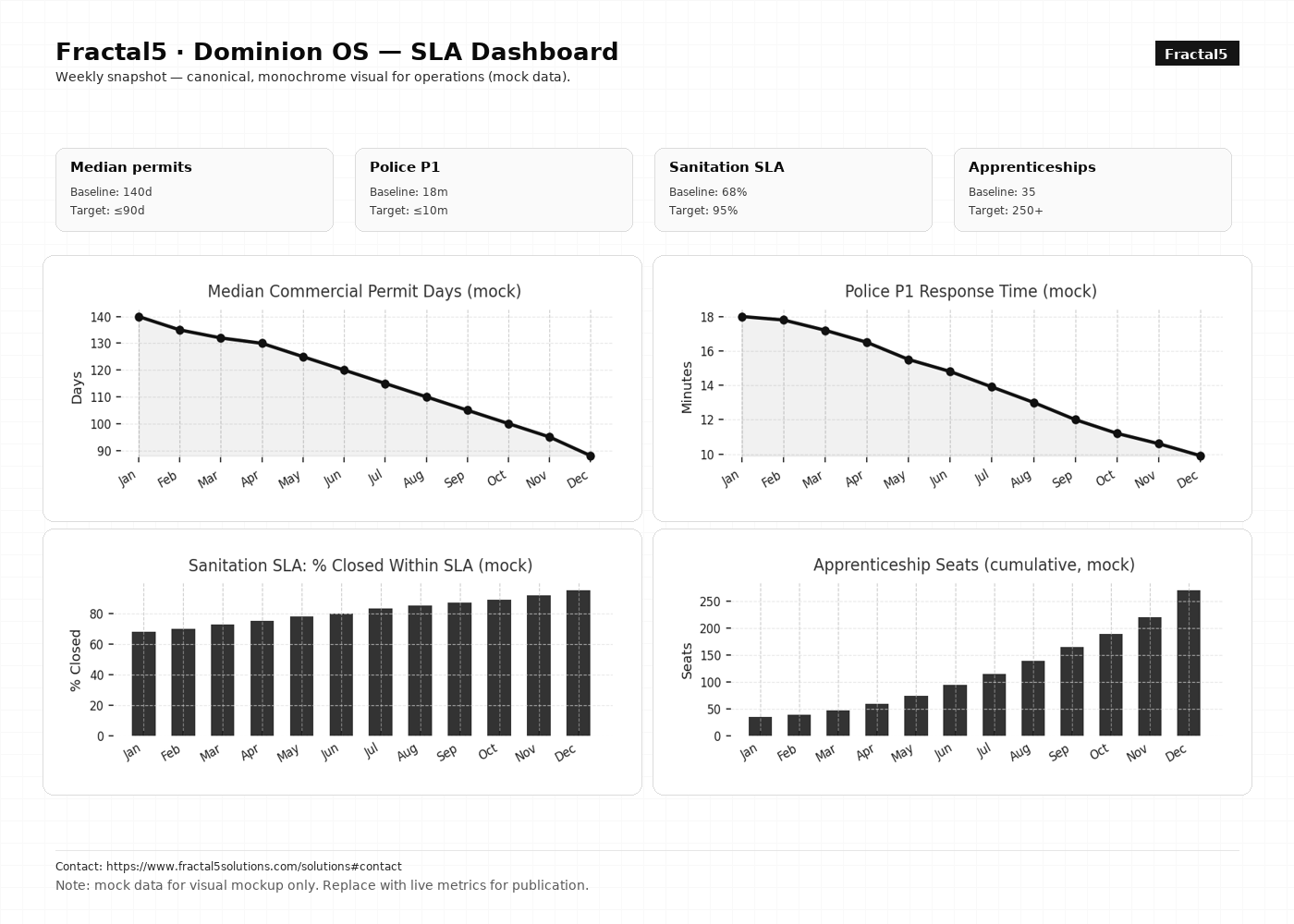
Permits (commercial median): baseline [___] days → target ≤ 90 days; infill residential: baseline [___] → ≤ 60 days.
Public safety: P1 response time baseline [___] min → ≤ 10 min; incident count in target blocks [___] → −30%.
Downtown vitality: vacancy baseline [___]% → [___ − 2–3] %; evening footfall [___] → + [___]%.
Youth employment: rate [___]% → [___ − 2–3] %; apprenticeships filled: 250+.
Business formation/survival: net‑new employers +[___]; 12‑month survival [baseline ___]% → [target ___]%.
The ask
To Council: regulate less, enforce better, decide faster. Adopt the permit shot‑clock, back the safety baseline, and publish the dashboard. To the Province: fund transitional housing, treatment capacity, and front‑line policing with clearly timed deliverables. To Ottawa: avoid piling unfunded compliance on small firms; if you require more rules, fund the front‑line delivery.
As Council prepares to consider a motion on memberships—specifically the Urban Development Institute—this moment requires nuance, not reflex. Councillor Stephen Hammond has argued that taxpayers should not fund lobby groups, and that review is reasonable. But a blunt cut that fails to distinguish between private lobby groups and civic institutions would be a mistake.
One such institution is the Greater Victoria Chamber of Commerce, led by CEO John Wilson. I support Wilson’s unapologetic leadership and the Chamber’s role in this crisis. Wilson’s voice—sharp, public, and persistent—has done what leadership must: name the problem clearly and demand action. That is not partisan posturing; it is stewarding the city’s economic backbone. The Chamber’s modest annual membership (roughly $1,800) is not a subsidy to lobbying so much as a small investment in a formal channel for Business‑to‑City coordination: workforce pipelines, employer apprenticeship commitments, procurement partnerships, and rapid feedback on permitting bottlenecks.
If Council is serious about results, it should separate the legitimate policy concerns about funding private developer lobbies from the practical value of an institutional relationship with the Chamber. Keep the Chamber membership—maintain the formal line to business leadership—and insist on regular public reporting of joint initiatives, outcomes, and value‑for‑money. That preserves the Chamber’s role as the unapologetic voice for business while holding the organization and its public partners accountable to delivery.
To the builders of Victoria—retailers, restaurateurs, coders, carpenters, mariners: keep your nerve. Prosperity is not a mood; it’s a method. Build local, hire local, stay locally connected and grow!