
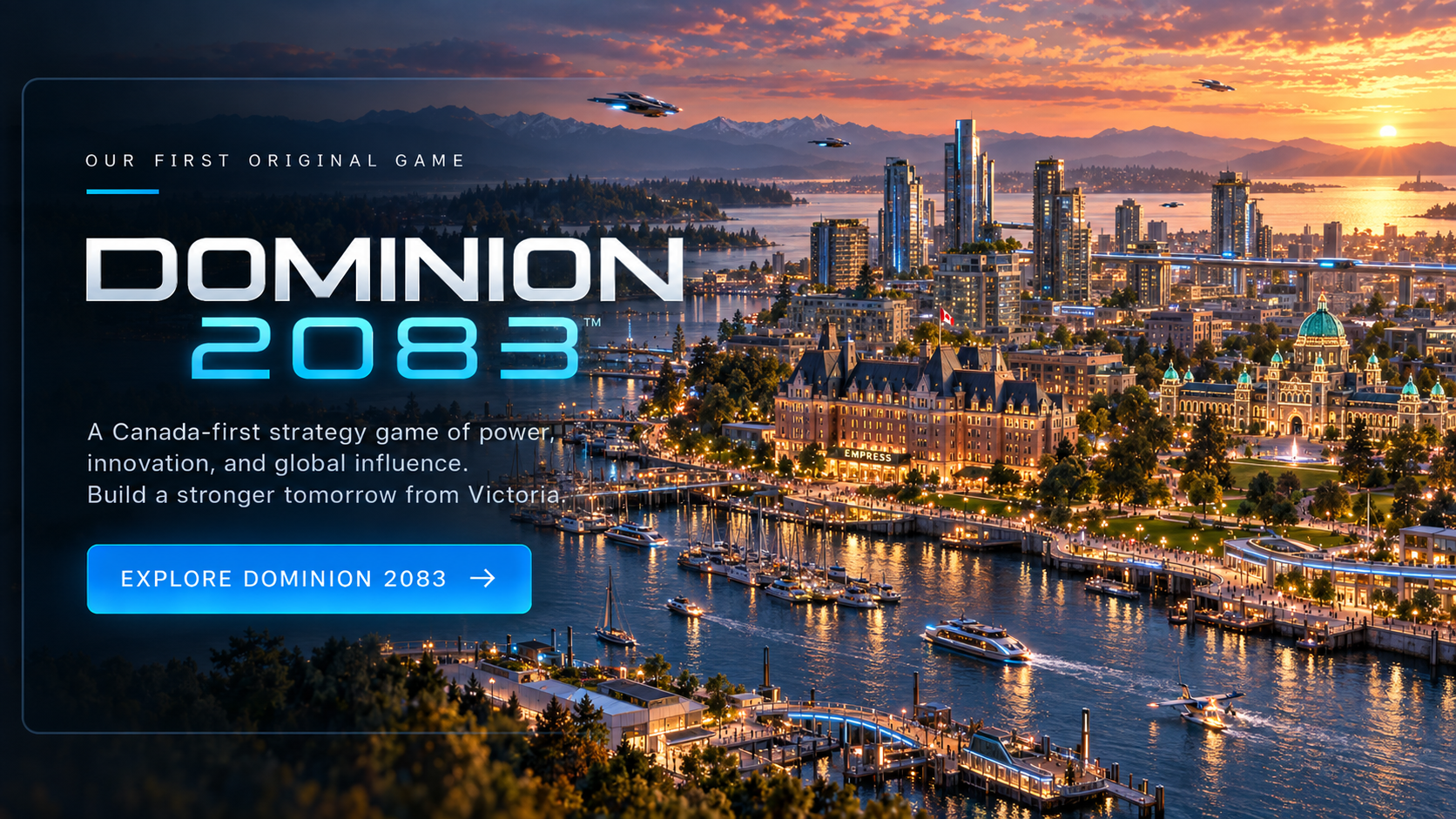
Dominion 2083
A global strategy game of people, places and possibilities.
Lead a real nation through a changing century. Population, economy, resources, climate, technology, infrastructure, institutions, security and geopolitics interact inside one evolving strategic simulation. Your decisions reshape what becomes possible.
Real Nations × Interconnected Systems × Persistent Consequence
A country is not a skin. It is a system.
Dominion 2083 is built around distinct national simulations.
Geography, people, institutions, resources, economic structure, infrastructure, climate exposure, strategic position and social conditions create different realities for every country. Each nation should create materially different pressures, possibilities and choices.
Every nation is a unique simulation.
Canada is the first deeply developed national simulation and the primary world through which Dominion 2083 is being built. Other countries remain long-term game vision until their own systems are developed.
🇨🇦 Canada
First deeply developed national simulation and the current core world.
🇺🇸 United States
Distinct continental, federal, industrial and geopolitical systems.
🇬🇧 United Kingdom
Island geography, institutions, trade, alliances and regional dynamics.
🇩🇪 Germany
Industry, energy, demographics, Europe and continental infrastructure.
🇫🇷 France
Institutions, strategic autonomy, industry, agriculture and global reach.
🇯🇵 Japan
Technology, demographics, energy, cities and maritime strategy.
🇮🇳 India
Population, development, technology, infrastructure and strategic growth.
More Countries
Brazil, Australia and additional national worlds can follow the same rule: distinct systems, not reskins.
Country labels beyond Canada describe planned game direction. They do not represent completed simulations, playable releases or committed launch content.
Resilient. Connected. Influential.
Canada begins with extraordinary geography, natural resources, established institutions, advanced cities, northern sovereignty, Pacific and Atlantic gateways, and significant exposure to technological, demographic, environmental and geopolitical change.
Those strengths are not guarantees. They are strategic conditions. What Canada becomes depends on the decisions made along the way.
Victoria & Vancouver Island
Government, Pacific access, ports, defence, technology, marine systems, energy, housing, resilience, Indigenous relationships and island logistics.
Vancouver
Trade, finance, immigration, housing, infrastructure, innovation, port systems, urban density, supply chains and Pacific commerce.
Sovereignty & Opportunity
Arctic access, defence, climate change, critical infrastructure, Indigenous communities, resources, transportation, security and northern growth.
Food, Energy & Transformation
Agriculture, energy, water, logistics, advanced production, urban growth, land use, automation and continental trade.
Population & Industrial Power
Manufacturing, finance, government, infrastructure, advanced industry, population growth, cities and continental networks.
Ocean, Energy & Connection
Marine industries, ports, energy, demographic change, fisheries, defence, trade, climate exposure and Atlantic connectivity.
One nation. Many systems. One evolving state.
The strategic surface is schematic rather than cartographic: it shows how regional pressures, national systems, forecasts and player choices converge inside National Command.
Everything affects something else.
Major decisions move through multiple systems, produce trade-offs and create consequences that can emerge immediately or decades later.
Population
Demographics, migration, health, education, workforce, communities, quality of life and social change.
Economy
Productivity, employment, investment, industries, trade, fiscal capacity, affordability and resilience.
Resources
Energy, minerals, water, food, forests, land, strategic materials and movement systems.
Climate
Wildfire, drought, storms, coastlines, heat, cold, adaptation and changing regional conditions.
Geopolitics
Alliances, trade relationships, security, diplomacy, international pressure, competition and influence.
Technology
AI, robotics, energy systems, transportation, communications, biotechnology, defence and automation.
Stability
Institutions, trust, cohesion, legitimacy, public safety, disruption and societal pressure.
Opportunity
New industries, regional development, innovation, strategic openings, emerging capabilities and human potential.
Countries are made of people.
Population is not intended to exist only as a national statistic. Decisions become legible through the lives, opportunities, pressures and perspectives of people inside the simulation.
Everyday Life
Households, communities, consumers, neighbours, newcomers and future generations.
Build & Operate
Trades, professionals, entrepreneurs, researchers, operators, creators and industry participants.
Organize Society
Governments, businesses, public institutions, civil society, universities and strategic organizations.
Caretakers & Defenders
Health, education, emergency response, public safety, defence and other essential services.
Plausible. Purposeful. Visible.
Dominion 2083 remains recognizably connected to the world we inhabit now. Future cities, transportation, energy, communications, defence, automation and infrastructure evolve from real geography and physical constraints.
Move people, goods, and strategic capacity.
Ports, rail, roads, aviation, public transit, autonomous systems, shipping, logistics and strategic corridors determine how the country actually functions.
Power the country under changing demand.
Generation, transmission, grids, storage, fuels, electrification, resilience, industrial demand and regional energy systems interact.
Connect the national system.
AI infrastructure, compute, communications, satellites, cybersecurity, automation, sensors and intelligent systems create the connective layer of 2083.
Beauty and threat occupy the same world.
The physical environment is not scenery. Seasons, climate, terrain, wildfire, water, snow, drought, coastlines, agriculture, forests, storms and regional conditions shape what countries can do and what they must respond to.
Consequences accumulate.
Some decisions matter immediately. Others alter trajectories across years or decades. Dominion 2083 is ultimately about the future created by accumulated choices.
Different countries. Distinct worlds.
Dominion 2083 is intended to expand beyond Canada while preserving the same rule: each country should remain recognizably itself.
Real geography, institutions, demographics, resources, economic structure, infrastructure, history and strategic position inform the simulation. Expansion means developing new national systems, not swapping labels on a shared generic model.
The future should still feel real.
Dominion 2083 uses grounded futurism. Existing cities and landscapes remain geographically recognizable while architecture, transportation, technology, infrastructure, vehicles, interfaces and physical systems can evolve dramatically.
Grounded Futurism
The future grows out of physical, institutional and geographic constraints.
Authentic Places
Recognizable cities, coastlines, terrain and strategic geography remain meaningful.
Human Centred
Technology changes the world without erasing the people living inside it.
Systems Visible
Infrastructure, institutions, economy and environment should be readable through the world itself.
Beauty & Threat
A compelling future can also contain pressure, fragility and strategic danger.
Global Consistency
Shared visual discipline supports a coherent global game.
Distinct Nations
Each country retains its own visual and systemic identity.
Victoria Canon
Recognizable Victoria geography, harbour relationships and landmark placement remain the baseline when the city is depicted.
Building the world before pretending it is finished.
Dominion 2083 is an original Fractal5 Games project in development. Public materials distinguish concept work, design canon, systems planning, prototype work and future production.
Worldbuilding
Core premise, national model, Canadian regions and global-game direction.
Visual Canon
Grounded futurism, authentic geography, people, infrastructure and strategic-interface language.
Game Systems
Population, economy, resources, climate, geopolitics, technology, stability, opportunity and consequence.
Playable Systems
Interfaces, world state, playable loops, scenarios, agents, simulation and architecture.
Concept art is not gameplay. Design canon is not a finished build. Prototype work is not a released title. Platform pathways are not publishing approval. Public language should continue to distinguish each of those states.
Strategy first. Platform second.
Dominion 2083 is conceived first as a deep strategy experience. Platform decisions follow the finished game's interface, performance needs, publishing path, audience and development state.
Platform references describe potential development pathways and do not imply endorsement, certification, publishing approval, licensing, partnership, release commitment or affiliation unless explicitly stated. Xbox is a trademark of the Microsoft group of companies. PlayStation is a trademark or registered trademark of Sony Interactive Entertainment Inc. Nintendo Switch is a trademark of Nintendo. Steam is a trademark and/or registered trademark of Valve Corporation. Other trademarks belong to their respective owners.